Capital Gain Securities Tax Calculator Pakistan 2025-2026
This is latest Capital Gain on Securities Tax calculator as per 2025-2026 budget presented by Government of Pakistan.
Capital Gain Securities Tax Calculator
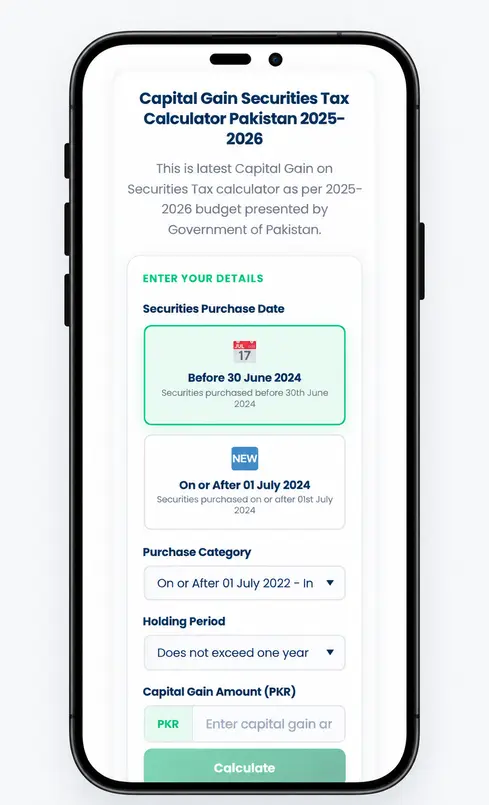
Enter Your Details
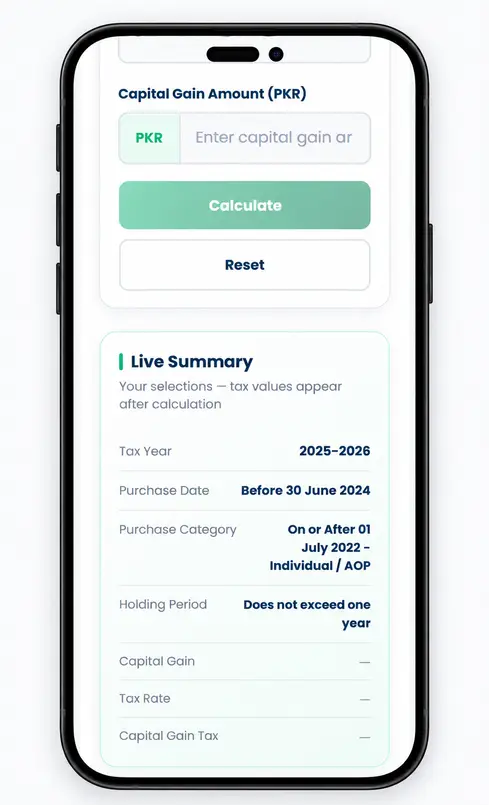
Your Capital Gain Securities Tax Results
Based on FBR capital gain on securities tax rates for 2025-2026
Capital Gain Securities Tax Calculator Pakistan 2026-2027
The Capital Gain Securities Tax Calculator Pakistan helps investors estimate tax on profits from the disposal of securities in Pakistan.
Capital gains tax on securities is mainly governed by Section 37A of the Income Tax Ordinance, 2001. The applicable rate can depend on when you acquired the security, how long you held certain older securities, your Active Taxpayer List status, and the type of security involved.
The rules changed significantly from 1 July 2024. Finance Act 2026 also changed the treatment of persons who are not appearing on the ATL.
For this reason, you should not calculate every securities gain using one flat percentage.
How to Use the Capital Gain Securities Tax Calculator
Start by identifying when you acquired the security.
The calculator should separate acquisitions into two periods:
Enter your capital gain in Pakistani rupees.
For securities acquired between 1 July 2022 and 30 June 2024, you also need the holding period.
For securities acquired on or after 1 July 2024, ATL status becomes especially important. Current law distinguishes taxpayers appearing on the ATL on both the acquisition and disposal dates from taxpayers who do not satisfy that condition.
The result should be treated as an estimate. NCCPL’s actual CGT computation can include prescribed adjustments and netting rules.
What Is Capital Gain Tax on Securities in Pakistan?
Capital gain is the profit that arises when a security is disposed of for more than its acquisition cost.
Section 37A uses this basic formula:
Capital Gain = Consideration Received – Cost of Acquisition
For example, suppose you acquired shares for Rs 500,000 and later sold them for Rs 650,000.
Your simplified capital gain would be:
Rs 650,000 – Rs 500,000 = Rs 150,000
The applicable CGT rate is then applied according to the relevant rules.
Section 37A treats this gain as a separate block of income.
Actual NCCPL computation can also account for prescribed transaction-expense adjustments.
Which Securities Are Covered Under Section 37A?
The legal definition of security is broader than ordinary company shares.
Section 37A includes items such as:
Debt securities can include instruments such as TFCs, Sukuk, bonds, commercial paper, Treasury Bills and Pakistan Investment Bonds. The definition of derivative products also includes qualifying PMEX future commodity contracts.
However, different instruments can have special tax rules. Do not assume one rate applies to every item in this definition.
Capital Gain Tax Rates on Securities in Pakistan 2026-27
The acquisition date is one of the most important factors.
Securities Acquired From 1 July 2022 to 30 June 2024
This acquisition period uses the holding-period rate structure.
Holding Period | Base CGT Rate |
|---|---|
Up to 1 year | 15% |
More than 1 year up to 2 years | 12.5% |
More than 2 year up to 3 years | 10% |
More than 3 year up to 4 years | 7.5% |
More than 4 year up to 5 years | 5% |
More than 5 year up to 6 years | 2.5% |
More than 6 years | 0% |
These reduced rates apply specifically to securities acquired between 1 July 2022 and 30 June 2024.
This point is important because some online calculators still ask for a holding period even when the security was acquired after 1 July 2024.
That can produce an incorrect result.
Securities Acquired On or After 1 July 2024
A different rule applies to securities acquired on or after 1 July 2024.
The rate is 15% where the person appears on the Active Taxpayers’ List on both:
For persons who do not satisfy the ATL condition, the law refers to the rates in Division I for individuals and AOPs and Division II for companies.
For individuals and AOPs not appearing on the ATL, the applicable rate cannot be less than 15%.
This means the post-July-2024 regime should not be calculated using the older one-year, two-year and six-year holding-period table.
How ATL and Non-ATL Status Affects Securities CGT
ATL status is increasingly important for capital gains.
FBR itself lists a lower withholding tax rate on capital gains from securities among the benefits of appearing on the ATL.
There is also an important Finance Act 2026 change.
The Tenth Schedule states that where tax is required to be deducted or collected from someone not appearing on the ATL, the applicable rate is generally increased by 100%.
Previously, there was a specific exclusion for tax collected under Section 37A on securities acquired on or after 1 July 2025. The current Income Tax Ordinance records that this exclusion was removed by Finance Act 2026.
This is why a calculator for 2026-27 should not simply copy a 2025-26 ATL and non-ATL rate table.
At the time this article was researched, NCCPL’s public CGT table was still labeled Year 2026 CGT Rates. FBR’s current Ordinance, amended through 30 June 2026, should therefore be checked for the latest Tax Year 2027 position.
How Is Capital Gain on Securities Calculated?
The simple calculation is:
Capital Gain = Sale Consideration – Acquisition Cost
Then:
Estimated CGT = Capital Gain × Applicable Rate
Suppose your gain is Rs 400,000 and the applicable rate is 15%.
Rs 400,000 × 15% = Rs 60,000
Estimated CGT would be Rs 60,000.
However, NCCPL’s actual market computation is more detailed.
NCCPL states that for market-based PSX transactions it applies a prescribed expense adjustment of 0.5% for a client’s trade and 0.25% for a broker’s proprietary trade for expenses such as brokerage, commission, transaction fees and similar charges.
Therefore, a simple manual calculation is useful for estimating tax, but your NCCPL certificate may not match a basic sale-minus-purchase calculation exactly.
Capital Gain Tax Calculation Examples
Example 1: Securities Acquired in 2022 and Held for More Than 3 Years
Suppose an investor acquired securities on 1 August 2022.
The securities are later sold after 3 years and 4 months.
Capital gain:
Rs 500,000
Applicable base holding-period rate:
7.5%
Calculation:
Rs 500,000 × 7.5% = Rs 37,500
Estimated base CGT:
Rs 37,500
The 7.5% rate works because the securities were acquired between 1 July 2022 and 30 June 2024.
Example 2: ATL Investor Acquiring Securities After 1 July 2024
Suppose an investor acquired listed securities in August 2025 and appears on the ATL on both the acquisition and disposal dates.
Capital gain:
Rs 500,000
Applicable rate:
15%
Calculation:
Rs 500,000 × 15% = Rs 75,000
Estimated CGT:
Rs 75,000
The old holding-period reduction does not apply merely because the investor holds these securities for several years. The acquisition falls under the post-July-2024 regime.
Example 3: Securities Acquired Before July 2013
Suppose qualifying securities were acquired in 2012.
Capital gain on disposal:
Rs 1,000,000
Applicable statutory rate:
0%
Estimated CGT:
Rs 0
The acquisition date changes the result completely.
What Does NCCPL Do With Capital Gains Tax?
The National Clearing Company of Pakistan Limited (NCCPL) plays a central role in the CGT system for Pakistan’s capital market.
NCCPL states that it has been mandated by FBR to compute, determine, collect and deposit CGT on listed securities covered by its regime.
For investors, several NCCPL functions are particularly important.
NCCPL collects CGT monthly based on net capital gain through the relevant securities brokers.
It can also refund excess CGT through brokers when later losses reduce the investor’s net capital gain during the tax year.
NCCPL submits quarterly information to FBR.
At the end of the year, NCCPL issues an Annual Certificate of Capital Gains. NCCPL states that this certificate is considered conclusive evidence of the capital gain and the tax thereon.
This certificate is therefore an important document when preparing your income tax return.
What Happens When You Make a Capital Loss?
Capital losses on securities also have special rules.
Section 37A states that a loss from securities can be set off only against gains from other securities chargeable under the same section.
It cannot simply be used against salary or unrelated business income.
For losses arising in tax year 2019 and onward, an unused qualifying securities loss may be carried forward for up to three immediately succeeding tax years. It can still only be used against qualifying Section 37A securities gains.
NCCPL also states that adjustment of prior-year capital losses through its CGT system is subject to the taxpayer’s ATL status being available to NCCPL.
This is an important area that most competing calculator pages do not explain.
Common Capital Gain Tax Calculation Mistakes
One common mistake is using the holding period without checking the acquisition date.
The reduced 15% to 0% holding-period schedule is not a universal rule for every security sold today. It applies to the specified acquisition period from 1 July 2022 through 30 June 2024.
Another mistake is checking ATL status only on the sale date for post-July-2024 securities. The current statutory 15% rule refers to ATL status on both the acquisition date and disposal date.
Investors also sometimes enter the total sale value instead of the capital gain.
If shares costing Rs 800,000 are sold for Rs 1,000,000, your simplified gain is Rs 200,000, not Rs 1,000,000.
Another common error is treating mutual funds, PMEX futures, debt securities and ordinary listed shares as identical investments. Different rules can apply.
Finally, do not rely on an old 2024-25 or 2025-26 calculator without checking the latest FBR law.