
Balochistan Agricultural Income Tax Calculator (2025–2026)
Calculate Balochistan Agricultural Income Tax according to official 2025–2026 tax slabs.
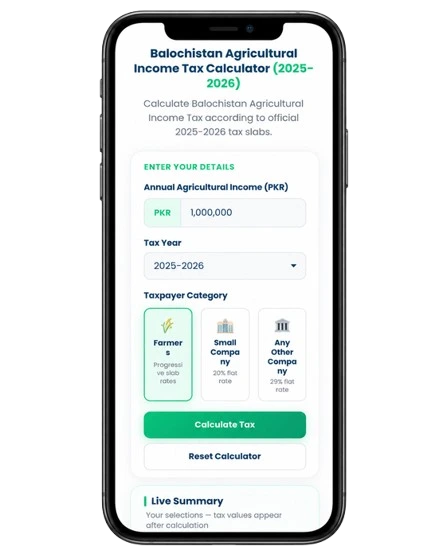
Balochistan Agricultural Income Tax Calculator
Enter Your Details
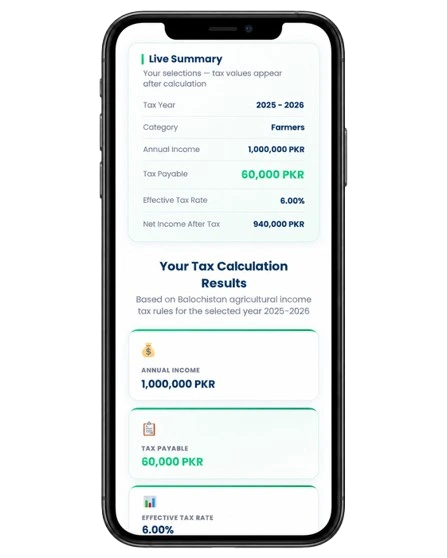
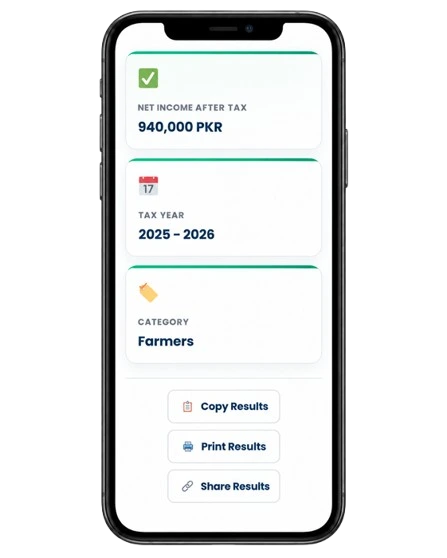
Your Tax Calculation Results
Based on Balochistan agricultural income tax rules for the selected year 2025-2026
About Balochistan Agricultural Income Tax
Use the Balochistan Agricultural Income Tax Calculator to estimate agricultural income tax on farming income in Balochistan. The calculation is different from ordinary salary or business income tax because agricultural income is taxed under provincial law rather than the normal federal income tax system. Federal Section 41 exempts qualifying agricultural income from tax under the Income Tax Ordinance, while Balochistan imposes its own agricultural income tax.
Current-rate note: The latest official Balochistan rate-changing law verified for this update is Act VIII of 2025, which amended the Balochistan Tax on Land and Agricultural Income Ordinance, 2000 and came into force from January 1, 2025. Official sources reviewed through September 19, 2026 did not surface a later Balochistan schedule replacing these rates, so the tables below use the latest officially verified schedule.
For a correct estimate, the calculator should consider more than annual farm income. A Balochistan landowner may also be subject to a per-acre minimum tax, and very high agricultural income can attract a separate super tax.
What is it?
Agricultural income tax in Balochistan applies to profits and gains from agricultural land, crops, corporate farming ventures and allied activities. Tax rates vary by income level, taxpayer category and the applicable tax year.
Who should pay?
Individual farmers, landowners and corporate farming entities operating in Balochistan may be liable. For 2025-2026 and 2024-2025, categories include individual farmers (slab-based rates), small companies (20% flat rate) and other companies (29% flat rate).
Why use this calculator?
This free tool helps farmers, accountants and business owners estimate tax liability before filing returns. Enter your annual agricultural income, select the tax year and category, and receive a detailed breakdown including effective tax rate and net income after tax.
How to use the Balochistan Agricultural Income Tax Calculator
Start by selecting the type of taxpayer:
Then enter your annual agricultural income. If you own the agricultural land, also enter the information needed for the land-based calculation, including the applicable Balochistan tax zone and your irrigated, unirrigated and mature orchard acreage. The official schedule uses different rates for Zones I, II, III and IV.
For ordinary cultivated land, two acres of unirrigated land are treated as equivalent to one irrigated acre for the First Schedule calculation. Mature orchard land is excluded from the ordinary acreage bands and is taxed at separate irrigated or unirrigated orchard rates.
Do not enter gross crop sales automatically as “taxable agricultural income” unless that is the amount determined under the applicable law for your situation. The provincial law controls the computation of total agricultural income, and more complex cases involving rent-in-kind, mixed business activities or unusual farm arrangements may require professional review.
Enter Your Annual Income
Enter your total annual agricultural income in Pakistani Rupees (PKR). This is the gross income from your farming or agricultural business before tax deductions.
Tax Slabs
Individual farmers are taxed using progressive slabs — higher income falls into higher rate brackets. Corporate categories use flat percentage rates (20% for small companies, 29% for other companies in supported recent years).
Select tax year
Select the financial year that applies to your return. Supported years are 2025-2026, 2024-2025, 2023-2024 and 2022-2023. Slab rates may differ between years, so choosing the correct year is essential for an accurate estimate.
Taxpayer Category
For 2025-2026 and 2024-2025, choose Farmers, Small Company or Any Other Company. Older tax years use individual slab rates automatically. The calculator applies the correct formula for your selection without any manual calculation.
Balochistan agricultural income tax rates
For an individual farmer, the latest verified Balochistan agricultural income tax slabs are:
Annual agricultural income | Balochistan agricultural income tax |
|---|---|
Up to Rs 600,000 | No Tax |
Rs 600,001 to Rs 1,200,000 | 15% of the amount over Rs 600,000 |
Rs 1,200,001 to Rs 1,600,000 | Rs 90,000 + 20% of the amount over Rs 1,200,000 |
Rs 1,600,001 to Rs 3,200,000 | Rs 170,000 + 30% of the amount over Rs 1,600,000 |
Rs 3,200,001 to Rs 5,600,000 | Rs 650,000 + 40% of the amount over Rs 3,200,000 |
Above Rs 5,600,000 | Rs 1,610,000 + 45% of the amount over Rs 5,600,000 |
The first Rs 600,000 is therefore within the nil band for an individual under the current schedule. Moving into a higher bracket does not mean the higher percentage is applied to all previous income. Each formula applies the stated fixed amount plus the marginal rate on the excess above that bracket’s starting point.
For example, agricultural income of Rs 1,500,000 produces an income-based tax of Rs 150,000:
Rs 90,000 on income up to the previous bracket limit, plus 20% of Rs 300,000, which is Rs 60,000. The total is Rs 150,000. This follows the statutory formula for income above Rs 1.2 million and up to Rs 1.6 million.
Agricultural income of Rs 3,000,000 produces an income-based amount of Rs 590,000:
Rs 170,000 plus 30% of Rs 1,400,000, giving Rs 170,000 + Rs 420,000 = Rs 590,000.
Balochistan agricultural land tax and the minimum-tax rule
Agricultural income is only one part of the calculation for a Balochistan landowner. The amended First Schedule also provides a per-acre tax, with rates varying by zone and land category.
Cultivated land | Zone I | Zone II | Zone III | Zone IV |
|---|---|---|---|---|
Up to 12.5 irrigated-equivalent acres | Nil | Nil | Nil | Nil |
Over 12.5 to 25 acres | Rs 1,200/acre | Rs 900/acre | Rs 500/acre | Rs 300/acre |
Over 25 to 50 acres | Rs 2,500/acre | Rs 1,700/acre | Rs 1,000/acre | Rs 600/acre |
Over 50 acres | Rs 3,500/acre | Rs 2,500/acre | Rs 1,500/acre | Rs 900/acre |
Mature irrigated orchard | Rs 3,500/acre | Rs 2,500/acre | Rs 1,500/acre | Rs 900/acre |
Mature unirrigated orchard | Rs 1,750/acre | Rs 1,250/acre | Rs 750/acre | Rs 450/acre |
For ordinary farmland, calculate the irrigated-equivalent acreage before selecting the applicable band. For example, 10 irrigated acres plus 10 unirrigated acres equal 15 irrigated-equivalent acres because two unirrigated acres are treated as one irrigated acre.
Mature orchards are dealt with separately under the schedule. They do not receive the ordinary 12.5-acre nil band shown for regular cultivated land. Instead, the schedule specifies separate orchard rates by zone and by whether the orchard land is irrigated or unirrigated.
Do you add the land tax to the income tax?
Not normally as two separate ordinary charges.
For a landowner, section 6 makes the First Schedule land amount a minimum tax. When the agricultural income tax calculated under the income schedule is less than the land-based First Schedule amount, the land-based amount controls. This means the basic comparison is effectively the higher of the income-based tax and the applicable land minimum.
Consider a simple example. Assume a landowner has:
The income-based calculation is 15% of the Rs 100,000 above Rs 600,000, giving Rs 15,000. Under the Zone II 12.5-to-25-acre band, the land calculation is Rs 900 per acre, giving Rs 18,000 on 20 acres. Because the land-based minimum is higher in this example, the ordinary provincial tax would be based on Rs 18,000 rather than Rs 15,000, subject to the taxpayer’s actual assessment and classification
Which Balochistan zone applies to my land?
The 2025 amendment creates Zones I, II, III and IV and authorizes the Board of Revenue, with government approval, to group districts into those zones. The amendment itself does not contain a district-by-district mapping
For that reason, do not select a zone based on guesswork. Use the zone applicable under the current Board of Revenue classification or confirm it with the relevant revenue authority. A calculator that assigns a zone without a verified official mapping can produce a materially wrong land-tax result because the per-acre rates vary substantially across the four zones.
Company agricultural tax and super tax
Companies do not use the individual progressive agricultural income tax table. The amended Balochistan schedule provides a 20% agricultural income tax rate for a small company and 29% for any other company
Company type | Agricultural income tax rate |
|---|---|
Small company | 20% |
Other company | 29% |
“Small company” is a legal tax classification linked by the Balochistan amendment to the definition in the Income Tax Ordinance. A company should therefore confirm that it meets the applicable legal definition rather than selecting the option simply because the farm is small.
For example, a qualifying small company with Rs 10 million of agricultural income would have an income-based calculation of Rs 2 million at 20%, before considering any other applicable provision such as the land minimum. Because Rs 10 million is below the Rs 150 million super-tax threshold, the agricultural super tax table would not apply in that example.
Agricultural super tax in Balochistan
A separate super tax applies to very high agricultural income under the amended law. The verified schedule is:
Agricultural income | Super tax rate |
|---|---|
Up to Rs 150 million | NIL |
More than Rs 150 million up to Rs 200 million | 1% |
More than Rs 200 million up to Rs 250 million | 2% |
More than Rs 250 million up to Rs 300 million | 3% |
More than Rs 300 million up to Rs 350 million | 4% |
More than Rs 350 million up to Rs 400 million | 6% |
More than Rs 400 million up to Rs 500 million | 8% |
More than Rs 500 million | 10% |
The statutory table describes these percentages as rates on income. This calculation should therefore be displayed separately from the ordinary progressive tax result so that a taxpayer can see exactly where the additional charge arises.
Is agricultural income taxed by FBR?
Qualifying agricultural income is exempt from federal income tax under section 41 of the Income Tax Ordinance, 2001. The current FBR version, consolidated through June 30, 2026, expressly states that agricultural income derived by a person is exempt from tax under the federal Ordinance.
Section 41 defines agricultural income around income connected with agricultural land in Pakistan. It covers qualifying rent or revenue from agricultural land, income from agriculture, ordinary processing required to make agricultural produce fit for market, qualifying sales of a cultivator’s own produce, and certain buildings closely connected with the agricultural land.
The federal exemption should not be confused with a complete tax exemption. Agricultural income can still be taxed by Balochistan under provincial law, and the Balochistan Board of Revenue identifies agriculture income tax assessment and collection as one of its functions.
This is why a normal income tax calculator Pakistan for salary, business or other FBR-taxed income should not simply be reused for Balochistan farm income. Agricultural income has its own provincial schedule and, for landowners, a separate land-based minimum calculation.
What if agricultural income is shown in an FBR return?
Federal exemption does not remove the provincial obligation. The Balochistan amendment specifically provides that where a person has declared agricultural income in a return filed under the Income Tax Ordinance, that person shall pay tax on the agricultural income under the Balochistan law.
Whether you are otherwise required to file an FBR income tax return depends on the federal filing rules applicable to your circumstances. FBR currently provides return filing through Iris and requires registration for first-time filers.
The important point is that an FBR return and Balochistan agricultural income tax are not substitutes for each other.
Penalties for non-compliance
Agricultural income tax is not only a calculator issue. The amended Balochistan law also contains significant consequences for failing to meet provincial obligations.
For failure to furnish a required statement or return, the law provides a penalty calculated at 0.1% of the tax payable for each day of default or Rs 1,000 per day, whichever is higher. It also specifies minimum penalties according to the taxpayer’s agricultural income.
Total agricultural income | Stated minimum penalty |
|---|---|
Up to Rs 1.2 million | Rs 10,000 |
More than Rs 1.2 million up to Rs 40 million | Rs 20,000 |
More than Rs 40 million | Rs 50,000 |
The amended law requires that the taxpayer be given an opportunity of hearing in connection with the penalty provision.
Late payment can also trigger a default surcharge. The statutory rate is 12% per annum or KIBOR plus 3% per annum, whichever is higher, for the period of default, with the surcharge capped at 50% of the tax payable.
Because penalties and administrative requirements can depend on the actual return and assessment position, a calculator result should be treated as an estimate rather than an official provincial assessment.
Balochistan Agricultural Income Tax Calculator examples
Example: Agricultural income of Rs 1,000,000
The first Rs 600,000 falls within the nil band.
The remaining Rs 400,000 is taxed at 15%
Estimated income-based agricultural tax: Rs 60,000
Example: Agricultural income of Rs 1,500,000
The statutory formula for this band is:
Rs 90,000 + 20% of the amount above Rs 1,200,000.
The excess is Rs 300,000.
20% of Rs 300,000 is Rs 60,000.
Estimated income-based agricultural tax: Rs 150,000
Example: Agricultural income of Rs 3,000,000
The applicable formula is:
Rs 170,000 + 30% of the amount above Rs 1,600,000.
The excess is Rs 1,400,000.
30% of Rs 1,400,000 is Rs 420,000.
Estimated income-based agricultural tax: Rs 590,000
Example: Agricultural income of Rs 6,000,000
he applicable formula is:
Rs 1,610,000 + 45% of the amount above Rs 5,600,000.
The excess is Rs 400,000.
45% of Rs 400,000 is Rs 180,000.
Estimated income-based agricultural tax: Rs 1,790,000
Calculator Benefits
A modern, trustworthy tool designed for farmers, tax professionals and businesses across Balochistan.