
KPK Agricultural Income Tax Calculator (2025–2026)
Calculate KPK Agricultural Income Tax according to official 2025–2026 tax slabs.
KPK Agricultural Income Tax Calculator
Enter Your Details
Your Tax Calculation Results
Based on KPK agricultural income tax rules for the selected year 2025-2026
KPK Agricultural Income Tax Calculator 2026-2027
The KPK Agricultural Income Tax Calculator helps farmers and agricultural businesses estimate their agricultural income tax in Khyber Pakhtunkhwa.
KPK introduced a new agricultural tax system through the Khyber Pakhtunkhwa Agricultural Income Tax Act, 2025. The Act took effect from 1 January 2025 and replaced the older 2000 agricultural tax law.
Under the current system, agricultural income up to Rs 600,000 falls in the zero-tax bracket for small farmers. Progressive rates then rise from 15% to 45% within the published individual schedule.
The province also uses land-based agricultural tax rates. Therefore, an income-only calculation may not always represent the final agricultural tax assessment for a landowner.
This calculator gives an estimate based on agricultural income. If you also own or cultivate agricultural land, check the separate KPK Agricultural Land Tax Calculator as well.
How to Use the KPK Agricultural Income Tax Calculator
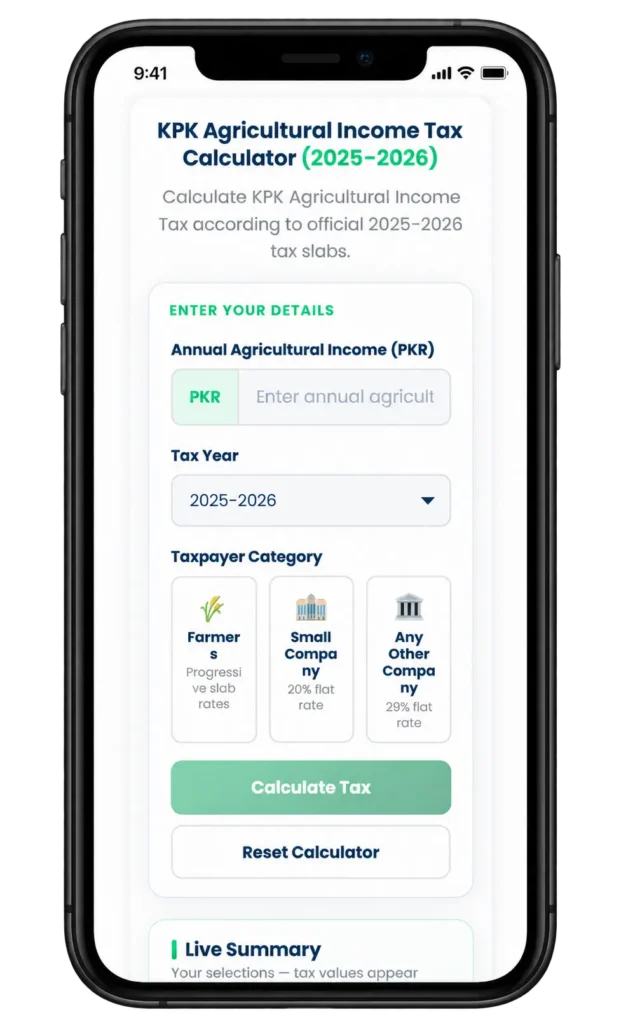
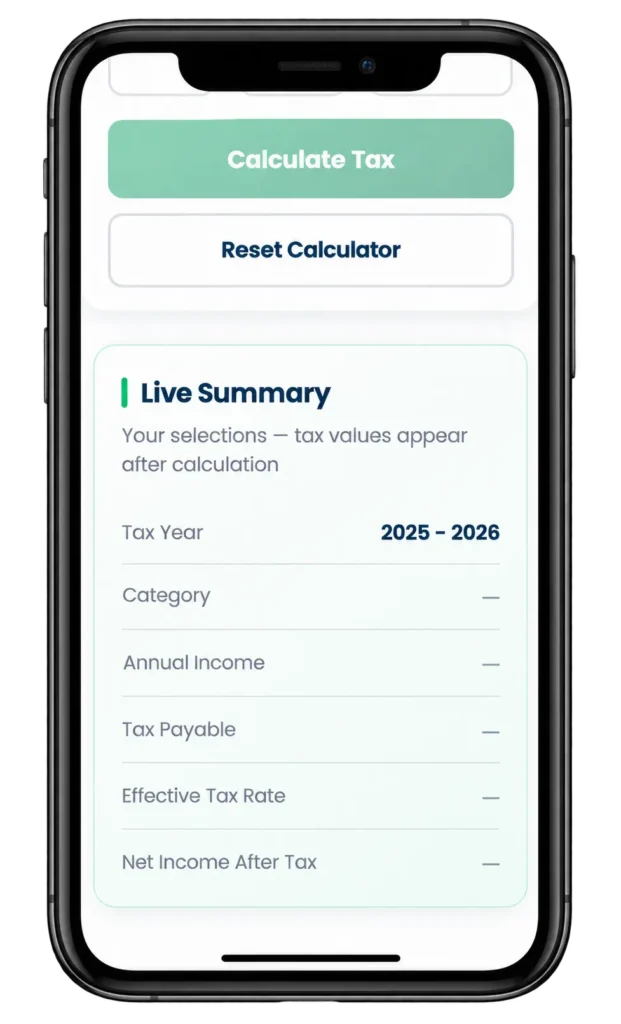
Using the calculator is simple.
For an individual farmer, the calculator applies the progressive agricultural income tax slabs.
A qualifying small company uses a 20% rate. Other companies engaged in corporate farming use a 29% rate.
Do not enter ordinary salary or non-agricultural business income into this calculator.
The tool is specifically intended for agricultural income covered by the Khyber Pakhtunkhwa agricultural income tax law.
KPK Agricultural Income Tax Rates 2026-27
Total agricultural income | Tax calculation |
|---|---|
Up to Rs 600,000 | 0% |
Rs 600,001 to Rs 1,200,000 | 15% of amount above Rs 600,000 |
Rs 1,200,001 to Rs 1,600,000 | Rs 90,000 + 20% above Rs 1,200,000 |
Rs 1,600,001 to Rs 3,200,000 | Rs 170,000 + 30% above Rs 1,600,000 |
Rs 3,200,001 to Rs 5,600,000 | Rs 650,000 + 40% above Rs 3,200,000 |
Above Rs 5,600,000 up to Rs 150 million | Rs 1,610,000 + 45% above Rs 5,600,000 |
These rates come from Division I of Part I of the Schedule to the Khyber Pakhtunkhwa Agricultural Income Tax Act, 2025.
The first Rs 600,000 is therefore not taxed for an individual covered by this schedule.
It is important to use the progressive formula correctly.
For example, someone earning Rs 1.5 million does not pay 20% of the entire Rs 1.5 million. The statutory formula applies Rs 90,000 plus 20% of the amount above Rs 1.2 million.
Important note for income above Rs 150 million
The original 2025 Act also introduced a separate agricultural super tax above Rs 150 million.
The KP Finance Act 2026 removed the super-tax section and deleted Division III of the Schedule.
However, the published Division I table still describes its highest ordinary slab as income above Rs 5.6 million but not exceeding Rs 150 million.
For this reason, this calculator should not automatically estimate 2026-27 tax above Rs 150 million without current clarification from the KP Revenue Department.
How Is Agricultural Income Tax Calculated?
For individual farmers, KPK uses progressive tax slabs.
Only the portion falling into the next band is taxed at the higher marginal rate.
Suppose your annual agricultural income is:
Rs 1,000,000
The first Rs 600,000 falls in the zero-tax band.
Remaining amount:
Rs 1,000,000 – Rs 600,000 = Rs 400,000
Tax:
Rs 400,000 × 15% = Rs 60,000
Estimated agricultural income tax:
Rs 60,000
The same progressive method applies to the higher brackets.
KPK Agricultural Income Tax Examples
Example 1: Rs 1 Million Agricultural Income
Annual agricultural income:
Rs 1,000,000
Taxable amount above Rs 600,000:
Rs 400,000
Tax:
Rs 400,000 × 15% = Rs 60,000
Estimated tax:
Rs 60,000
Example 2: Rs 1.5 Million Agricultural Income
Applicable formula:
Rs 90,000 + 20% of amount above Rs 1,200,000
Excess:
Rs 1,500,000 – Rs 1,200,000 = Rs 300,000
Additional tax:
Rs 300,000 × 20% = Rs 60,000
Total estimated tax:
Rs 90,000 + Rs 60,000 = Rs 150,000
Example 3: Rs 3 Million Agricultural Income
Applicable formula:
Rs 170,000 + 30% above Rs 1,600,000
Excess:
Rs 3,000,000 – Rs 1,600,000 = Rs 1,400,000
Additional tax:
Rs 1,400,000 × 30% = Rs 420,000
Total estimated tax:
Rs 590,000
Example 4: Rs 6 Million Agricultural Income
Applicable formula:
Rs 1,610,000 + 45% above Rs 5,600,000
Excess:
Rs 400,000
Additional tax:
Rs 400,000 × 45% = Rs 180,000
Total estimated tax:
Rs 1,790,000