
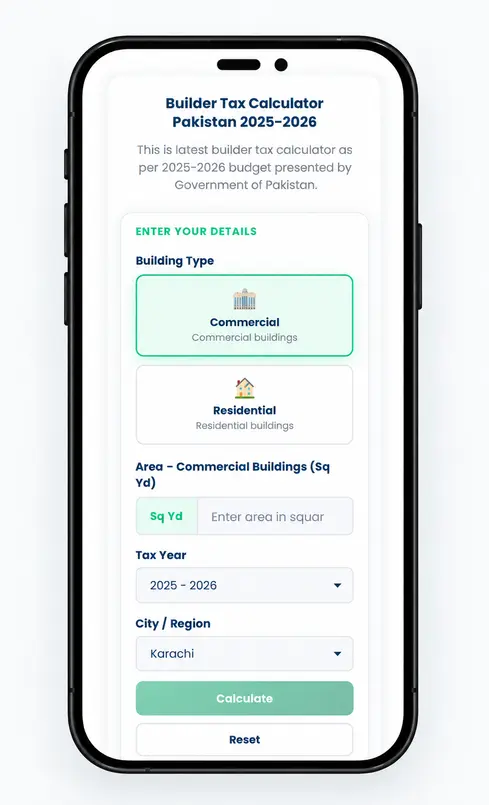
Builder Tax Calculator Pakistan 2025-2026
This is latest builder tax calculator as per 2025-2026 budget presented by Government of Pakistan.
Builder Tax Calculator Pakistan
Enter Your Details
Your Builder Tax Results
Tax on Commercial Buildings for 2025-2026
Builder Tax Calculator Pakistan 2026-2027
The Builder Tax Calculator Pakistan 2026-2027 helps builders estimate area-based advance tax on construction projects in Pakistan.
Enter your building type, covered area and project location. The calculator then applies the relevant FBR rate for your city group.
This calculation is particularly useful for commercial and residential construction projects. Current builder advance-tax rates depend on the project’s covered area, building type and location.
The calculation covered by this tool relates to the adjustable advance-tax mechanism under Section 147(5C) of the Income Tax Ordinance, 2001. FBR’s current law requires qualifying builders and developers to pay this tax on a project-by-project basis in four equal instalments.
How to Use the Builder Tax Calculator Pakistan?
Choose the Tax Year
Select the year for which you want to calculate the taxes. option of 2024-2025 or 2025-2026
Choose Property Type
You can choose “Commercial Property” or “Residential Property.”
Enter Property Area
Start by entering your property area in Square Yard where you want to built the project
Choose Project Location
you can choose any city from the given list where you want to start the project
View Results
Then tap on calculate tax to Get results visualized with detailed breakdowns
What Does This Builder Tax Calculator Calculate?
This calculator estimates the adjustable advance tax payable by builders under Section 147(5C).
FBR requires persons deriving income from the construction and disposal of residential, commercial or other buildings to pay advance tax on a project-by-project basis. The amount is calculated using the rates provided in Part IIB of the First Schedule
The tax is payable in four equal instalments.
This means the calculator can show:
Builder Tax Rates in Pakistan 2026-2027
FBR divides locations into three groups for these calculations.
Group A Cities | Group B Cities | Group C |
|---|---|---|
Karachi, Lahore and Islamabad | Hyderabad, Sukkur, Multan, Faisalabad, Rawalpindi, Gujranwala, Sahiwal, Sialkot, Bahawalpur, Peshawar, Mardan, Abbottabad and Quetta | Group C covers other urban areas that are not included in Group A or Group B. |
Commercial Building Tax Rates
For commercial buildings, the current Section 147(5C) rates are:
Project Location | Advance Tax Rate |
|---|---|
Karachi, Lahore and Islamabad | Rs 250 per sq ft |
Group B cities | Rs 230 per sq ft |
Other urban areas | Rs 210 per sq ft |
FBR applies these commercial building rates regardless of the size of the covered area
Commercial Building Example
Suppose a builder is constructing a 2,000 square foot commercial building in Islamabad.
Islamabad falls in Group A.
Rate: Rs 250 per sq ft
Calculation: 2,000 × Rs 250 = Rs 500,000
Estimated total adjustable advance tax: Rs 500,000
If paid in four equal instalments: Rs 500,000 ÷ 4 = Rs 125,000
Estimated instalment: Rs 125,000
This example shows why entering the correct covered area and location is important
Residential Building Tax Rates
Residential buildings use two area categories.
Covered Area | Group A | Group B | Group C |
|---|---|---|---|
Up to 3,000 sq ft | Rs 80/sq ft | Rs 65/sq ft | Rs 50/sq ft |
3,000 sq ft and above | Rs 125/sq ft | Rs 110/sq ft | Rs 100/sq ft |
These are the current rates shown in FBR’s Part IIB schedule for Section 147(5C)
Residential Building Example
Suppose a builder constructs a 2,500 square foot residential building in Peshawar.
Peshawar falls in Group B.
For a residential building up to 3,000 square feet, the Group B rate is:
Rs 65 per sq ft
Calculation: 2,500 × Rs 65 = Rs 162,500
Estimated total advance tax: Rs 162,500
Four equal instalments would be: Rs 162,500 ÷ 4 = Rs 40,625
Estimated instalment: Rs 40,625
A Note About Exactly 3,000 Square Feet
There is a small issue in the wording of the official FBR table.
The first residential category says “up to 3000”, while the second says “3000 and above.” Both descriptions therefore include exactly 3,000 square feet in their literal wording.
A calculator should not silently pretend that this wording does not exist.
For a project with exactly 3,000 square feet, users should verify the applicable treatment with FBR or a qualified tax professional if the distinction affects the amount payable.
Why Project Location Changes Builder Tax
Builder advance tax is not the same in every Pakistani city.
A commercial project in Islamabad uses Rs 250 per square foot. The same covered area in Peshawar uses Rs 230 per square foot. A qualifying project in another urban area uses Rs 210 per square foot.
This is why the Builder Tax Calculator Pakistan asks you to select your project location.
Choosing the wrong city group can produce an incorrect estimate.
Commercial vs Residential Builder Tax
Commercial and residential projects do not use the same rates.
Commercial buildings use one rate for any covered area within each city group.
Residential buildings use separate rates depending on whether the covered area falls within the lower or higher area category.
For example, a residential building in Lahore may use Rs 80 per square foot at the lower area level but Rs 125 per square foot at the higher level.
The calculator should therefore ask for both building type and covered area before calculating the result.
What About Mixed-Use Buildings?
Some projects contain both residential and commercial portions.
FBR specifically states that where a building has both commercial and residential areas, the respective rates apply to each part.
For example, suppose a project contains shops on the ground floor and apartments above them.
The commercial covered area should be calculated using the relevant commercial rate.
The residential covered area should be calculated using the applicable residential rate.
A future advanced version of the calculator could allow users to enter both areas separately.
Why Our Calculator Uses Square Feet Instead of Square Yards
Some older online builder calculators still ask users to enter commercial or residential building area in square yards.
Your competitor’s current page, for example, displays inputs for commercial and residential buildings in square yards and labels the result as annual income tax. Its written guide also contains older rates such as Rs 210 per square yard for commercial projects and Rs 20, Rs 40 and Rs 70 per square yard for residential projects.
The current FBR Part IIB table is different.
For commercial and residential buildings, the official measurement is square feet, not square yards.
Square yards are used in the separate schedule for development of plots.
This Builder Tax Calculator therefore uses square feet for building calculations.